I came slow into awareness of the horror of the past week, and still it comes slow, but heavier each day. There are stories and pictures and Wen Jiabao flew in, old and frail as he is, they all sigh, to give commands and tell the little girls not to cry. Still they cried. They're estimating in the end it may be more than 50,000 dead.
On Monday afternoon I was on my balcony, squinting at the sun which glared off my laptop. At 3:30 I got an SMS message from my Chinese tutor (who's always forwarding me messages) about Sichuan, where he knows I used to live and love. An earthquake, 7.8 on the Richter scale occurred at 2:30 it said. "An earthquake," I think, "hmm." And that's about all I think. I'm trying to write through my thoughts from the weekend's existential psychology workshop. The will-to-meaning is what keeps us alive, says Frankl.
At 1:00 before the world changed ZX had called, wanting to know if I had ideas about how to donate in China for Burma relief. We talked for just a few minutes while I sat in the sun on my balcony with my laptop and my coffee. The world was beautiful.
At 4:00 when he calls again the world is still beautiful; I'm baking perfect cookies. I try to answer, it cuts off, and I can't get through back to him. "My phone must be out of money," I think. "I'll have to run to the LianTong place before going to the office this evening." But time slips away, and I end up hurrying to the office at a quarter to 7:00 just in time for the evening's workshop.
But when I arrive there is unusual energy in the conversation and FR and GX have a crazy story. There was an earthquake in the afternoon, they say. We felt it, and evacuated the building. They tell their story - how the floor began to sway underneath them, how they looked at each other, asking "what's happening?" and ran out the door and down the stairs. One flight down and FR decided she had to go back for the center's money. GX didn't want to let her, but she fought her way back up through the stream of people on the way down to grab the center's money, her wallet, and her MP3 player. GX told the software designers in the office next to ours, "There's an earthquake!" but they didn't move. Everyone else, it seems, flew down and outside to stand around with their bags and their cellphones, or whatever they thought to grab.
Suddenly there was connection and fear and I tried to call ZX again. And again. And again. I used FR's phone, and finally got through. He's fine. There's a big crack in his parent's building. Everyone is out on the sports field, and afraid to go near buildings, some in their pajamas, but fine.
We don't talk until later about how they all were sure the buildings would fall. His coworker screamed, "It's over!", sure she was about to die. Others were so frightened they jumped from the seventh floor and, tragically, did die.
Everyone I know is okay, but still it hurts. Former students, who are mostly from Sichuan, have undoubtably suffered losses, though I haven't heard specific stories. I want to be with my friends in Sichuan. I feel helpless and far away (as many of they do too). The horror of how lives have been turned upside down sinks in more every day.
Someone finds online a teacher's blog from the high school in Beichuan where a thousand kids were buried in rubble. The last post is pictures of the kids and teachers enjoying a sports day twenty-four hours before the earthquake. I find myself fighting back tears in the middle of the afternoon.
I call my friend Iris, who is a fourth-year nursing student back in Nanchong. The school is sending a group of nurses into the harder hit areas. Hundreds want to go, but there is space for only twenty nursing students. Iris says if she is chosen, she wouldn't tell her parents, knowing they would worry so much. But she isn't accepted, and I'm a little relieved, because I would have worried about her too. We laugh about how I might have been accepted to go - they were mainly looking for sturdy-built nurses - ones that could work long hours and not collapse without food and water. My roommate, who in general gets bright-eyed about soldiers, told me reverently last night how a bunch of them fainted from overexertion, or lack of sleep, or food, or whatever.
A big rescue team from Japan was allowed in today, a few days late, if you're asking some people. Why do they even bother with money? FR asks. Who cares about how much money has been donated when people are dying? The instant noodle factories should just load their trucks up and drive in there to donate it themselves. This is China, they say, shaking their heads how at a time like this, there are still people who can only think about making a buck. (But it's not China, it's the world, I want to tell them.) At the office I get laughed at for having donated money through SMS. She can't believe that I would be so stupid as to fall for the scams. But I've grown used to the ridicule, and it doesn't touch me. (At some point, I want to tell her, you have to start trusting, and if I was wrong this time, 12 RMB is not much of a price to pay.)
My friend William writes on his blog about his experience in Jiangyou (close to Mianyang).
Showing posts with label FR. Show all posts
Showing posts with label FR. Show all posts
Friday, May 16, 2008

Monday, May 5, 2008
to peixian and back
Some thoughts on the "labor day" holiday in FR's hometown. On the first night, when we had come in late, then eaten mutton kebabs on the street with an old classmate, then talked a bit with her parents, and were at 3 am finally preparing to sleep she asked what time I would get up in the morning. I laughed and said, "I guarantee it will be before you" because she can sleep a whole day away, and does regularly when she has the chance. She told me she doesn't sleep late at home. I guess if getting up grudgingly, at 9:30, after Mom announces breakfast at 8:30 is not late, then okay, but I still got up before she did.
I got sick the second day. I think I may have experienced my first migraine, after waaaay too much food at Grandpa's 70th birthday party. They put me beside Grandma, who kept putting salty duck egg halves into my hand, and later, onto the little paper birthday cake plate (cake was first). And I was not prepared for the second course of delicious stewed chicken and mushrooms and mantou AND porridge. Later in the afternoon the two aunts teamed up in the kitchen to demonstrate the making of homemade tortilla chips (a treat that they usually make at the Chinese New Year). They make them with sesame seeds, and they're delicious, if a little greasier than how I think of tortilla chips. I'm anxious to try making a batch on my own, and see what baking does, and to make salsa to eat with the big bag we brought home.
I always call FR a true "product of China" and seeing where and how she grew up just increased my feeling on this. She's just so typical of how her generation is supposed to be. How she came from the countryside to the city for middle school and then Nanjing for college and for work, how she's caught between her family's heavy expectations and her own dreams, how she is sooooo apolitical but so certain that China is the best country in the world. I don't mean to put her into a box, but I really do think of her like this, and am fascinated each time I understand a little more where she came from and why she is the way she is, which we both agree, is sometimes sooooo different from me. Though her mom says we're similar. We both like to eat a lot and are somewhat ungirly. We both thought going out after lunch to sit by the wheat fields, under the flickering silver leaves of the birch trees was a fine way to spend the afternoons.
There was the loneliness that comes when you're surrounded by another family united and miss your own. There was the boredom that comes when hours are spent playing with babies on couches at houses of relatives you don't know, and when you only brought one book anyway. There was the doubt that comes when you think of ZX and the bittersweet pangs when the landscaped-sided river and spring in a mid-sized city reminds you of the other that you love.
Meeting FR's middle school classmates, who are the people she's kept most contact with through college and into this year, was fun. I mistook the huge lumbering guy who met us at the bus station in the middle of the night for another taxi driver trailing us in hope of some business - until FR abruptly turned to me and said, "Let me introduce..." The affectionate couple who laughed their way through lunch. He wants to study music at Berkeley in the US. She's a videographer. We just skimmed the surface of the Olympic/Tibet/Carrefour/China/West thing, but all knew better than to get into it with near strangers, and FR caring so little, unable to help smooth things over.
On the long, slow, hot trainride back to Nanjing I chatted with a youngish hydroelectric engineer for awhile. The urbanization movement peaked in the 80s, he said. Now it's so hard to buy a house, so people aren't so much staying in the cities, just going for awhile to make money, then they'll go home. It was obvious that he is planning to stay at his job in the Nanjing suburbs indefinitely, though he'll need a raise before he'll be able to consider buying a house. He asked repeatedly about where I've been and where I plan to live/travel in the future. He understood that I'm sort of wondering the world, living a vagrant life, which I guess isn't all that far wrong when you look at end results. But I'm such a serious person, I protested. He recommended novels by 舒童, with whom I share a family name. I surprised myself by expressing my hopes that the Olympics will go smoothly. Maybe I was just trying to balance a bit after saying a little too honestly that I'm not really interested in going to see the Olympics in Beijing. The tickets aren't hard to get or expensive, he said. You just have to have the time.
I got sick the second day. I think I may have experienced my first migraine, after waaaay too much food at Grandpa's 70th birthday party. They put me beside Grandma, who kept putting salty duck egg halves into my hand, and later, onto the little paper birthday cake plate (cake was first). And I was not prepared for the second course of delicious stewed chicken and mushrooms and mantou AND porridge. Later in the afternoon the two aunts teamed up in the kitchen to demonstrate the making of homemade tortilla chips (a treat that they usually make at the Chinese New Year). They make them with sesame seeds, and they're delicious, if a little greasier than how I think of tortilla chips. I'm anxious to try making a batch on my own, and see what baking does, and to make salsa to eat with the big bag we brought home.
I always call FR a true "product of China" and seeing where and how she grew up just increased my feeling on this. She's just so typical of how her generation is supposed to be. How she came from the countryside to the city for middle school and then Nanjing for college and for work, how she's caught between her family's heavy expectations and her own dreams, how she is sooooo apolitical but so certain that China is the best country in the world. I don't mean to put her into a box, but I really do think of her like this, and am fascinated each time I understand a little more where she came from and why she is the way she is, which we both agree, is sometimes sooooo different from me. Though her mom says we're similar. We both like to eat a lot and are somewhat ungirly. We both thought going out after lunch to sit by the wheat fields, under the flickering silver leaves of the birch trees was a fine way to spend the afternoons.
There was the loneliness that comes when you're surrounded by another family united and miss your own. There was the boredom that comes when hours are spent playing with babies on couches at houses of relatives you don't know, and when you only brought one book anyway. There was the doubt that comes when you think of ZX and the bittersweet pangs when the landscaped-sided river and spring in a mid-sized city reminds you of the other that you love.
Meeting FR's middle school classmates, who are the people she's kept most contact with through college and into this year, was fun. I mistook the huge lumbering guy who met us at the bus station in the middle of the night for another taxi driver trailing us in hope of some business - until FR abruptly turned to me and said, "Let me introduce..." The affectionate couple who laughed their way through lunch. He wants to study music at Berkeley in the US. She's a videographer. We just skimmed the surface of the Olympic/Tibet/Carrefour/China/West thing, but all knew better than to get into it with near strangers, and FR caring so little, unable to help smooth things over.
On the long, slow, hot trainride back to Nanjing I chatted with a youngish hydroelectric engineer for awhile. The urbanization movement peaked in the 80s, he said. Now it's so hard to buy a house, so people aren't so much staying in the cities, just going for awhile to make money, then they'll go home. It was obvious that he is planning to stay at his job in the Nanjing suburbs indefinitely, though he'll need a raise before he'll be able to consider buying a house. He asked repeatedly about where I've been and where I plan to live/travel in the future. He understood that I'm sort of wondering the world, living a vagrant life, which I guess isn't all that far wrong when you look at end results. But I'm such a serious person, I protested. He recommended novels by 舒童, with whom I share a family name. I surprised myself by expressing my hopes that the Olympics will go smoothly. Maybe I was just trying to balance a bit after saying a little too honestly that I'm not really interested in going to see the Olympics in Beijing. The tickets aren't hard to get or expensive, he said. You just have to have the time.
Tuesday, April 29, 2008
all the things you haven't heard
I can still feel the humiliation of the kindergarten cafeteria scene in which my friends discovered (to their dismay) that I did not know who Elvis Presley was, so I tried to go gentle with my astonishment when we found out FR had never heard of Adolph Hitler. GX was watching the propaganda film that he said was guaranteed to make even a Jew love the man. I wasn't so convinced - maybe it's related to all the propaganda I was raised on (and I mean this in the best sense) - the shivers I get from military marching tunes and videos of soldiers marching to them are much more horror than awe-inspired.
Anyway, I tried not to laugh too much, and told her to go baidu "hitler." I don't know if she has, but this morning she was baidu-ing away about the train wreck reported on the front page of the newspaper. She showed me the article and the website that provided a little box with a simulation of the accident. One train was going too fast, fishtailed a bit, collided with another passing train. 7o people died, just like that. Most of them were probably asleep.
Then we talked about how we always feel like trains are so safe, but was it ZX that said that you're safer on a plane? I think this is what my students meant when they wrote that news should be "close to my life." Tomorrow evening we take the train to her hometown (or to the closest town) for the labor day holiday. We ain't comin' back 'til Sunday.
Yesterday evening I reunited with my Chinese tutor after a strange three-week break. I brought him a bottle of water. He brought me a flower that he picked from a vine. At 5:45 we left the picnic table where we always meet near White Horse Park, and I headed towards the yoga place. When I ducked into a Lanzhou noodle place for supper, a young guy was reading a headline from a newspaper aloud to his two friends. Something about the US and Spain. I never did understand, but my curiousity won me some new friends (we exchanged telephone numbers, I invited them to English Island next week) and a gifted lamb skewer. Another guy waiting for his take-out order said, "Look at her shoes, look at her pants, they have a Chinese flavor. She's lived here for a long time." I told them that I bought the shoes in the US, and the pants in Cambodia.
My taiji instructor had met the Italian monk who lives in the monastery across the street and invited him to come practice with us. When he arrived, the middle-aged woman leaving after yoga was excited to tell him that she had read about him in the newspaper. BAO-ZHI! she said, real loud and distinct, even after being told (when she asked right in front of him) that he spoke excellent Chinese. I'm pretty sure the China Daily article that I read about him pointed out that he could speak Chinese, and I'd bet you a hundred yuan the one that she read had too.
Anyway, I tried not to laugh too much, and told her to go baidu "hitler." I don't know if she has, but this morning she was baidu-ing away about the train wreck reported on the front page of the newspaper. She showed me the article and the website that provided a little box with a simulation of the accident. One train was going too fast, fishtailed a bit, collided with another passing train. 7o people died, just like that. Most of them were probably asleep.
Then we talked about how we always feel like trains are so safe, but was it ZX that said that you're safer on a plane? I think this is what my students meant when they wrote that news should be "close to my life." Tomorrow evening we take the train to her hometown (or to the closest town) for the labor day holiday. We ain't comin' back 'til Sunday.
Yesterday evening I reunited with my Chinese tutor after a strange three-week break. I brought him a bottle of water. He brought me a flower that he picked from a vine. At 5:45 we left the picnic table where we always meet near White Horse Park, and I headed towards the yoga place. When I ducked into a Lanzhou noodle place for supper, a young guy was reading a headline from a newspaper aloud to his two friends. Something about the US and Spain. I never did understand, but my curiousity won me some new friends (we exchanged telephone numbers, I invited them to English Island next week) and a gifted lamb skewer. Another guy waiting for his take-out order said, "Look at her shoes, look at her pants, they have a Chinese flavor. She's lived here for a long time." I told them that I bought the shoes in the US, and the pants in Cambodia.
My taiji instructor had met the Italian monk who lives in the monastery across the street and invited him to come practice with us. When he arrived, the middle-aged woman leaving after yoga was excited to tell him that she had read about him in the newspaper. BAO-ZHI! she said, real loud and distinct, even after being told (when she asked right in front of him) that he spoke excellent Chinese. I'm pretty sure the China Daily article that I read about him pointed out that he could speak Chinese, and I'd bet you a hundred yuan the one that she read had too.
Monday, April 21, 2008
just so you know
In case you aren't lucky enough to actually live here like I do, you might not know that...
Everything good in the world is orginally Chinese, everything bad Western.
For example, there's capitalism (bad) - forced on China in the Qing dynasty (1800's) by the eight foreign powers, who after using military might (or GUNS, which we must remember, were NOT invented by Chinese people though they had long before invented gunpowder) to force their way into China's market, proceeded to post signs on the land they had stolen in Shanghai that read, "No Chinese or dogs allowed". It's hard to argue that capitalism hasn't been fully embraced here, but we'll argue that we never wanted it, never chose it.
And the all-inclusive, "openness" (bad) - immodesty, loose morality, and sex on TV, in movies, in young people's lives, is learned, of course, from the West, and mainly from "America", where everyone knows people wear as few clothes as they can get away with and divorce, sleep around, and in general assert their (scarily-extreme) independence as easily as they deposit their parents in an old folk's home.
Anais Mitchell sings (I think) about being a "westerner" in a place other than the "west" in "The Belly and the Beast" and I understand the general feeling ...
I, in my longing, fly out in the night
See, I want to complain about how I'm misunderstood, but really, I work with amazingly open people who understand relatively much about where I'm coming from and the mutual misunderstandings that we're all mired in and, best of all, they like to talk about it with me. We're all thinking a bit more politically these days; even my poor, very apolitical roommate is aware that something is going on because of the unavoidable buzz about boycotting Carrefour because we've been having these hours of conversations about politics and culture. I really think I understand a lot about China. I say to my roommate, "I really think I understand a lot about China," and then add, "but not enough."
unveiled and irreverently dressed
I'm lipstuck and liquored up, pickin' a fight
I'm the wicked, wicked witch of the west
"That's right, a little humbler!" she admonishes jokingly, and I know she's right, but I also wonder if "understanding China" for her doesn't meant holding the same views that every "good girl" is supposed to, 'cause I don't think I'll ever get there. Today we conclude our lunchtime lecture saying peacework is helping people in China and the west to understand each other more. I agree, I agree.
We pick up later with why the officials can't engage in real dialogue, because they have no "culture". (A related article about why officials shouldn't read, and I read the other day that the Pope can speak ten languages, and thought, "Now that guy deserves to be a leader!") . I mentioned this article, which offers China suggestions on "Putting the PR into the PRC" .
This was sort of the author's summary advice to China on how to come across a little more positively to the rest of the world.
Be confident and honest, not defensive and secretive
The outright denials of the obvious, the virulent rhetoric, the strained historical arguments, the paranoid claims that foreigners cause your problems - all make China look bad. And China does not need to look bad. Moreover, the world needs China not to look bad. China has a great deal to be proud and confident of, with an unprecedented record of poverty alleviation, phenomenal economic growth, glittering new architecture, high-levels of education, a space programme, trillions in foreign reserves, a savings rate that is the envy of spendthrift Americans, and what is likely to be a rich harvest of Olympic gold - not to mention a long history and glorious culture.
Sure, China has problems - who doesn't? But no one is going to take Tibet or Xinjiang away from China. If you respond to disturbances in these regions with restraint, with a statesmanlike air "more in sadness than in anger", and demonstrate an interest in attempting to resolve, rather than deny, the economic, cultural and political problems underlying these disturbances, you could earn world understanding and sympathy rather than looking like a bully.
I like this article because what he's saying is true: China has a lot going for it, and if it weren't so frustratingly defensive and secretive about everything, and stopped thinking, acting, and talking as if it's AGAINST the rest of the world rather than dealing with a lot of similar issues (a giant rich-poor gap, environmental issues, a multi-ethnic, multi-religious society, etc), things could be so much prettier. SW agrees, but there's little chance of that happening she seems to suggest, "The problem is that the officials lack confidence to really openly engage" even this country's own intellectuals, much less the international community. They have too much pressure - they're clinging tight to their power because it's not just power, but their means for survival (they're not lawyers or businessmen that changed professions, they're peasants that fought their way into these positions). You can think of China like a person, she says. They've had all this trauma (fuedalism, invasion from the west, from Japan, the cultural revolution). What China's people need is healing, and a real understanding of all the good that China has and is ... that can slowly grow into real confidence.
Last night when I couldn't stand to look at Chinese characters any longer I went out for a walk in the misty rain. When I handed my vegetables to the malatang guy so he could stew them in the pot of savory broth, he asked what country I'm from. It's such a common question, but weightier these days, so after I'd said "US", I asked, "but if I were from France, what would you do?"He didn't hesitate an instant. "不卖!" (he wouldn't sell me the soup!) and a big head-thrown-back laugh. I laughed with him, but couldn't resist a mini-speech about how he should know that the government isn't related to us common folk.
"Look at the American government, I said. They're bad, but I'm good!"
"I'm good too!" he said, and I said I knew. When the soup was done he brought it to my table, and welcomed me to come back again. When the girl at the table beside mine got up to leave she put the napkins from her table onto mine, and met my eyes with a smile. I was moved. Daily, I try to remember to worry less about these big things and go about the more important business of creating my own life.
My yoga instructor sweetly came to English Island on Friday night "second to practice English," she told me, and "first, to see you." She asked if I'd been busy recently, and I said I had (though not busy enough to explain why I haven't been to yoga in a good month). "I think you should practice more," she said simply, and I promised I'd be there tonight. Now that's love like it's supposed to be done.
Wednesday, April 16, 2008
economizing stories
When SW was young there were tall vats in which everyone in the courtyard would throw their food scraps. At primary school the teachers encouraged them to throw their leftover rice and dishes into them as well instead of into the regular trash. Peasants from the surrounding countryside would come daily to collect the scraps, dipping it up out of the vats into their barrels to take home to feed the pigs. Today they only do that for the restaurants, then it was everyone. The peasants would give the kids tickets (taomipiao 淘米票, lit. “wash rice tickets”) when they faithfully threw their scraps into the vats. The kids would then give their tickets to the teachers who would praise them; the tickets were like merits, to be collected; the more you had the better.
At the Suguo (the local convenience store chain), they are selling green light canvas bags for one kuai, which is nothing. The making of the super-thin bags has already been suspended (and factories closed, jobs lost), but the giving away of free plastic bags in the supermarkets ban doesn't start till June.
FR wonders if ALL the plastic bags in the land will be done away with. If that is the case, she thinks, then certainly there will people who will stockpile rolls of these trashcan-lining bags; they will fill rooms with them. We laugh at her.
We talk of how Chinese people used to (and even in
I try to explain how I still can feel the knowledge (and the will) buried, even in the current young people. You’re closer to it than we are in the
It's true, and an interesting cultural difference to think about, but what I'm trying to get at, and appreciate so much about China, is the economizing mindset that the society as a whole seems to have. Obviously it comes from a mixture of culture and poverty, and obviously its slipping away, but it's also still here.
When we were listing adjectives in English Island last week for a "good" person, there was "handsome" and "reliable" and "warm-hearted" and "smiling", and those were interesting, but the one that I liked the most? "Economic" (in Chinese, lit. "saving") Yes. That's why I live here.
Monday, April 14, 2008
the ordinary
It's been weird reading Justin's blog recently, as he's posting stuff he wrote while he was here. It's weird to go back and read someone else's perspective on things that you witnessed and (especially) that you had conversations about. Still, weird in a not un-nice way. Cause Justin is nice and doesn't write how I talked for hours about myself and had no idea which ATM took international cards. He admires things about my life that I don't always see, just like how I admire things about his that he doesn't necessarily see. That he gets out of bed in the mornings to write, and walks to the library to stack books for food (and rent). I admire the freedom in how he chooses friends and his books, and the cat, and the tea, and the principles as he wants to live them, no danger of his job defining him.
On the Tuesday after Justin left, inspired by the stretching before me of months unmarked by foreseeable visitors or trips, I decided to register myself for the April HSK exam, the Mandarin proficiency test for non-native speakers.
On the way to the registration office I passed a hotel billowing black smoke, people gathered around to watch. The fire engine wasn't getting anywhere fast, so it stopped 500 meters from the intersection and the firefighters got out and jogged to the scene in their ill-fitting yellow uniforms. One had to slow slightly to fix his helmet when it slipped down over his eyes. They were young, and I was filled with a sudden affection for all of them, and for the familiarity of the people gathering on the street corners to watch . . . as they would an argument . . . or anything, really.
On the Nanjing University campus I asked directions for the building whose name I hadn't understood on the phone (after asking her to repeat it four or five times I had gotten embarrassed and given up). The worker I stopped took pity on me and walked me to the nearest corner (opposite of the direction he was going) and carefully explained the turns I'd need to make. In the awkward space of his kindness and the steps to the corner I tried to make conversation. "I hadn't imagined that NanDa was so big!" I exclaimed. He turned to me with a mixture of confusion and sternness, and shortly replied, "Nanda is not big. It's not big at all."
On the Tuesday after Justin left, inspired by the stretching before me of months unmarked by foreseeable visitors or trips, I decided to register myself for the April HSK exam, the Mandarin proficiency test for non-native speakers.
On the way to the registration office I passed a hotel billowing black smoke, people gathered around to watch. The fire engine wasn't getting anywhere fast, so it stopped 500 meters from the intersection and the firefighters got out and jogged to the scene in their ill-fitting yellow uniforms. One had to slow slightly to fix his helmet when it slipped down over his eyes. They were young, and I was filled with a sudden affection for all of them, and for the familiarity of the people gathering on the street corners to watch . . . as they would an argument . . . or anything, really.
On the Nanjing University campus I asked directions for the building whose name I hadn't understood on the phone (after asking her to repeat it four or five times I had gotten embarrassed and given up). The worker I stopped took pity on me and walked me to the nearest corner (opposite of the direction he was going) and carefully explained the turns I'd need to make. In the awkward space of his kindness and the steps to the corner I tried to make conversation. "I hadn't imagined that NanDa was so big!" I exclaimed. He turned to me with a mixture of confusion and sternness, and shortly replied, "Nanda is not big. It's not big at all."
I found the registration office with ten minutes till closing. The man and the young woman behind the temporary office messy desk seemed bored, sharp contrast to my country mouse excitement. I tried to mask it, was glad I had everything ready, the two passport pictures and the money, and didn't have to ask them to help me read the form. It's good to taste once in awhile the expectation that I should actually be able to get along in the language of the land.
Later I went to the bookstore to look for books to help me study. Got mad that after almost four years I'm only ready for the basic level test. I was in the bookstore coffeeshop, looking at the prices of the desserts (thinking to buy time at the coffeeshop tables so I wouldn't have to buy the book) when a manager-ish man approached and asked if I would like to have a free cup of coffee. It was their first day, and they were doing test-runs, collecting comments. I asked him twice if he was serious.
In the end I had two different specials, and a chat with the actual manager, who was younger than me, as peppy as her hair was curled, a newly-gradeeaaated English major, and highly goal-oriented it seemed . . . but also (and why should this be surprising, really?) fairly pleasant to talk to. (It's probably just that she complimented my Chinese a lot. And she was from
My uncle asked in an email this morning about my thoughts on Tibet. I've been wanting to write more for awhile, and hope to soon, but my mind's a mess. I've been reading and reading - news, blogs, videos - from foreign journalists, Chinese alternative news, bloggers in China both western and Chinese, some of it good, some of it labeling and/or emotional, some of it only worth laughing at. I've gotten overwhelmed and depressed, and been comforted and relieved, then numb and tired of it all. I've thought I understood then been shocked with a new side of it. And there's the personal emotion all wrapped up in it because this thing of China being criticized (consistently) by the West is me and these are my friends and this my home. Then swirl in the added stuff of the discussions ZX and I have done over and over, almost nightly for awhile, swept away in the anger and defensiveness, the cultural views, then forcing ourselves to step away, to separate . . .
To cope, maybe, I started looking up stuff about Daosim. (Sunday's sabbath was good. To leave the computer at work for a whole day, read and write on the balcony, make food in the kitchen.) Started reading a book by Thomas Merton The Way of Chuang Tzu. I like this from "A Note to the Reader" in which he's explaining his appreciation for the philosopher and the "Dao",
But the whole "way" contained in these anecdotes, poems, and meditations, is characteristic of a certain taste for simplicity, for humility, self-effacement, silence, and in general a refusal to take seriously the aggressivity, the ambition, the push, and the self-importance which one must disply in order to get along in society.
Yes, we have that taste, some of us, don't we. Breathe, sigh, breathe. Look up at the world in a new way all over again. Later in the afternoon I hold FR's hand (like usual) as we walk to the supermarket. I don't think about the places I'd rather be (this is rather unusual) and laugh deep when she says the air "smells warm". I argue, that air can't 'smell warm' even though I agree that the description is true. But FR being FR responds to my half-serious protests with a full-out lesson about how in Chinese this is a valid way of saying it. It's a metaphor, see, similar to how we say she has a 'sweet' smile. We don't actually taste her smile . . .
Friday, April 11, 2008
we're all fooled and fooling
When he called on Monday, it was April Fool's, a holiday that people here seem to take much more seriously than I'm used to. So FR was convinced that my leaping heart would be thrown to the ground and stomped upon come Tuesday morning, and just kidding, he wouldn't be able to come, again. But my weak faith managed at least this much - that I drew a line,shook my head insisted, "If the ticket prices suddenly rose (like they can do in the space of minutes) maybe. But not a joke, not this cruel, and I was right.
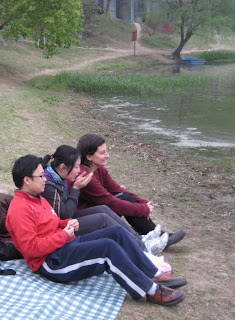 By Thursday the restoring faith had warmed me into lots of corners, like the sun subverting the weather reports for the holiday. We had two days off plus Sunday, went to bed late, like “睡得晚” and got up late, like "sleep late", spent other time on blankets on the ground overlooking lakes. The rain held off until we reached the restaurant Sunday night, seven of us young people come down from the mountain on a bus on a bike, giddy over how we occasionally met (I was sure they meant something closer to "happenstance") and running on the boardwalk and dirt paths around the small Pipa lake, backlit like the trees by floodlights the color of artificial spring green but still beautiful somehow.
 We hung out with my favorite friends, and with others who just happened to be along, and it didn't matter, really. I saw the games, marveled, enjoyed them mostly. ZX says that it can be so intricately woven that no words need be spoken, not a sword raised. The spirit of the eye, they say. And this is why we all love China. And hate it too.
Draught beer and big-bottled beer and walking and the black squeaky couch, FR beside us, tiring of our lapsing-into-English, voices-get-raised, drawn-out-too-long "discussions" of media bias. "Do you feel love for each other when you're talking about those things?" she asks, and I stubbornly insist I do, knowing that something in me is wired to enjoy conflict, from time to time. I also know she's a little bit right, and repent everyday, and try to remember to back down easily. I love friends who rebuke me, and when two of them sit together and we all are close, I am happy. This is a part of the story of the weeks since Justin left. April flies by.
 By Thursday the restoring faith had warmed me into lots of corners, like the sun subverting the weather reports for the holiday. We had two days off plus Sunday, went to bed late, like “睡得晚” and got up late, like "sleep late", spent other time on blankets on the ground overlooking lakes. The rain held off until we reached the restaurant Sunday night, seven of us young people come down from the mountain on a bus on a bike, giddy over how we occasionally met (I was sure they meant something closer to "happenstance") and running on the boardwalk and dirt paths around the small Pipa lake, backlit like the trees by floodlights the color of artificial spring green but still beautiful somehow.
 We hung out with my favorite friends, and with others who just happened to be along, and it didn't matter, really. I saw the games, marveled, enjoyed them mostly. ZX says that it can be so intricately woven that no words need be spoken, not a sword raised. The spirit of the eye, they say. And this is why we all love China. And hate it too.
Draught beer and big-bottled beer and walking and the black squeaky couch, FR beside us, tiring of our lapsing-into-English, voices-get-raised, drawn-out-too-long "discussions" of media bias. "Do you feel love for each other when you're talking about those things?" she asks, and I stubbornly insist I do, knowing that something in me is wired to enjoy conflict, from time to time. I also know she's a little bit right, and repent everyday, and try to remember to back down easily. I love friends who rebuke me, and when two of them sit together and we all are close, I am happy. This is a part of the story of the weeks since Justin left. April flies by.
Tuesday, February 26, 2008
dirty things
What do you assume when you see the cooks from the fancy restaurant on the first floor of the building dipping water out of the fountain with a cooking pot? I assumed that they were not cooking with the water. It was a sunny day – one of the warmest in a long time – I assumed that they were cleaning something. But there they were, young men in their medium-tall white chef hats lugging this huge 30-gallon pot between them. They dipped with efficiency, and without a second thought, avoiding the pipe system laid in the center of the narrow bed.
Last week I received a Valentine’s themed package from Rhoda and Jill. They sent me stupid kids things and circled “Made in
(I like it when Mom sends me stuff from Ten Thousand Villages – intricate paper reed Christmas ornaments and the rolled newspaper potholder - and my friends here ask if she made them herself.)
I had to walk a half an hour or so to get to the post office, down some streets I’ve never gone down before. On the way back on a whim I turned up an alley before I got back to the main road. It pointed in the right general direction, and Todd says that there’s always a way out of the twists and turns of
I wove between the “bread loaf” vans waiting to take passengers from the long distance bus station, stopping to wait for three-wheeled carts coming threading through, clanging their metal-on-metal warning. There were dirty little noodle shops with three tables, young women squatting over piles of slightly wilted green vegetables. I bought some raw peanuts from a vendor with feed sacks rolled open at the top and pleasantly full of oatmeal, dried peas turned white and cracked open, tiny dried round green beans, cracked corn.
The alley rose slightly, and narrowed, and was suddenly a fully-residential area, and mostly old buildings – three or four stories - and far enough from tall buildings that the sun was slanting in everywhere. People were strolling about in the sunny afternoon; a few were on the purple exercise machines in the tiny cement park area. I wandered. Some tall bamboo, and a few trees had been knocked over by the snow and still lay leaned against a brick wall. Green onions in a tiny raised garden bed were bent and brown broken tipped, but still alive. Beyond the wall I could hear and see the top of the other city, the one where my coworkers waited in the cold office on the twentieth floor.
February 24, 2008
Sunday morning I walked ten minutes down the road to the
Turns out the service started at 9:00, though I was far from the last one streaming in through the gates at 9:20. It was the first time I’d been to this church since September. Innocent little me stumbled into the main sanctuary and the prayer was just ending and the ushers wanted to ask some old women to scoot closer together to make room for me, but there still wasn’t really room enough. The place was completely full. I’ll sit outside, I told the usher. It’s too cold! she protested, but outside there were other ushers to direct me into another building and an elevator headed to the fourth floor. The elevator was packed, and I was afraid there weren’t even enough seats in the overflow when we walked through one room completely full and there was another branching off to the left. But I found a place directly beneath the TV in the middle of the room so I could still see the TV in the front of the room. I thought about how if I had gotten here early and not had a chance to sit here with hundreds of others in the overflow section, I wouldn’t have this sense of bigness of communal worship that I have.
The pastor – a middle aged, round-faced woman, was preaching about the three things Christians are called to. The scriptures were Ps 27:4, Luke 10:42, and Mark 10:21. So there were those things, and I’m pretty sure she was saying, “It’s not about what you eat.” But then at the end she still talked about how Christians shouldn’t eat blood (Acts and Leviticus), which is a real issue for many Chinese Christians, especially here in Nanjing where duck blood noodle soup is a local specialty. When church ended and we all surged out of the gates and down the street, and I joined a bunch of others to wait in line for “Soup-bag” snacks (which are somewhere between jiaozi and baozi, with sweet pork juice that bleeds out when you bite into the little steamed balls) . . . and I wondered if any of us there who’d just listened to the sermon were going to order duck blood soup, ‘cause they were selling it in the same shop.
While I was mixing up bread dough in the afternoon, I re-listened to the Speaking of Faith program with Karen Armstrong, “Freelance Monotheism” and was duly inspired. She talked about how we should take as much care with our theology as when doing poetry, and as much care in performing our religious rituals as when doing theater. She talked about how the thing that different faiths have in common is not doctrine but the call to practice compassion which then transforms us, the individual. A kind of alchemy, she laughs.
I think about how easy it is to love my roommate, who loved me first. I think of how hard it is to love others, who seem so fine on their own, buoyed up by their own ego and beliefs about the way the way the world is.
I love my roommate even though she sleeps all day. Really. And watches TV. I realize I’ve grown when the guy all self-righteous about his habits (“I don’t watch TV ‘cause it’s a waste of time) on the Chinesepod “World Cup Soccer” lesson sounded silly and narrowminded to me. Or maybe I already had decided that since he said soccer was just “跑来跑去(pao lai, pao qu).” See how easy compassion is?
Wednesday, November 7, 2007
in the end we fried them
Five layers on top and two on the bottom. Winter is here. Unpeeling to pee is a surreal sense of digging to uncover one's lost self. There are two big fish in a red plastic basin on the bathroom floor, with a rusty bottle cap at the bottom. One is dead, one breathes carefully. Poor TS. His gifts went unappreciated. The girl at the yoga place screwed up her face, gave the exact reply we had. You're giving me a live fish? I don't know how to fry fish!
Just make a soup with some tofu, he said.

 We went to his house for lunch Sunday. I sat in the sun - on a pillow on the wood floor - and tried to read self-help books in Chinese while almost everybody else hovered in the small kitchen. The lunch that resulted was incredible. Sweet, sour, spicy, salty - dishes to fit anyone's
  taste. Fish ball soup with mushrooms and cabbage and then we walked to the nearest park with a blanket and a pomelo. A perfect Sunday afternoon.
My roommates had decided to try to set TS up with another counselor. (He's 28, and already has a house; how could he not be ready for marriage?) They hadn't told me, and I didn't get it for a long time. I kept laughing at HY's, "No really, what kind of girl are you interested in?" and "Since you've bought an apartment in Nanjing you must want to marry a Nanjing girl!" and changing the subject, trying to protect the poor guy. In the end he was unruffled and maintained an enigmatic near-silence on the subject.
Just make a soup with some tofu, he said.

 We went to his house for lunch Sunday. I sat in the sun - on a pillow on the wood floor - and tried to read self-help books in Chinese while almost everybody else hovered in the small kitchen. The lunch that resulted was incredible. Sweet, sour, spicy, salty - dishes to fit anyone's
  taste. Fish ball soup with mushrooms and cabbage and then we walked to the nearest park with a blanket and a pomelo. A perfect Sunday afternoon.
My roommates had decided to try to set TS up with another counselor. (He's 28, and already has a house; how could he not be ready for marriage?) They hadn't told me, and I didn't get it for a long time. I kept laughing at HY's, "No really, what kind of girl are you interested in?" and "Since you've bought an apartment in Nanjing you must want to marry a Nanjing girl!" and changing the subject, trying to protect the poor guy. In the end he was unruffled and maintained an enigmatic near-silence on the subject.
Subscribe to:
Posts (Atom)